
There was a drawer in the kitchen I grew up in that stuck about two-thirds of the way open. You had to lift the front edge and pull. I had not thought about that drawer in twenty years, and I could not have produced it if you had asked me what I remembered about that kitchen; the question is too wide to catch anything. I produced it because someone asked a narrower one: which thing in that kitchen didn’t work properly?
That is the entire method, and what follows is twelve versions of it. A cue is a piece of the world that was there at the time — a doorway, a smell, a route, a Tuesday — offered back to you on its own, without a story attached.
One scope note, stated once and not returned to: this is an article about ordinary remembering, the everyday business of getting back into a period of your own life. It is not about memory impairment, and nothing here explains anyone’s mind to them. If that is what you came for, this is not the page.
And one promise I am not going to make. No cue below produces a result. Cues change the odds: a well-aimed one is more likely to find a match than a vague one, and that is all anyone can honestly claim. Some of these will land on nothing. That is a normal outcome of the method, not a failure of the reader.
What a cue is actually doing
The working principle comes from Endel Tulving and Donald Thomson, who stated it in 1973: the specific operations performed at encoding determine what is stored, and what is stored determines which retrieval cues can reach it (Psychological Review, 80, 352–373). Their evidence was word lists in a laboratory, not childhoods, and it is worth being straight about that: the autobiographical extension is later work by other people. But the shape of the principle survives the translation. A cue works to the degree that it overlaps with the conditions the episode was laid down under. “Think about your childhood” overlaps with nothing in particular. A stuck drawer overlaps with one kitchen, on a few hundred specific evenings.
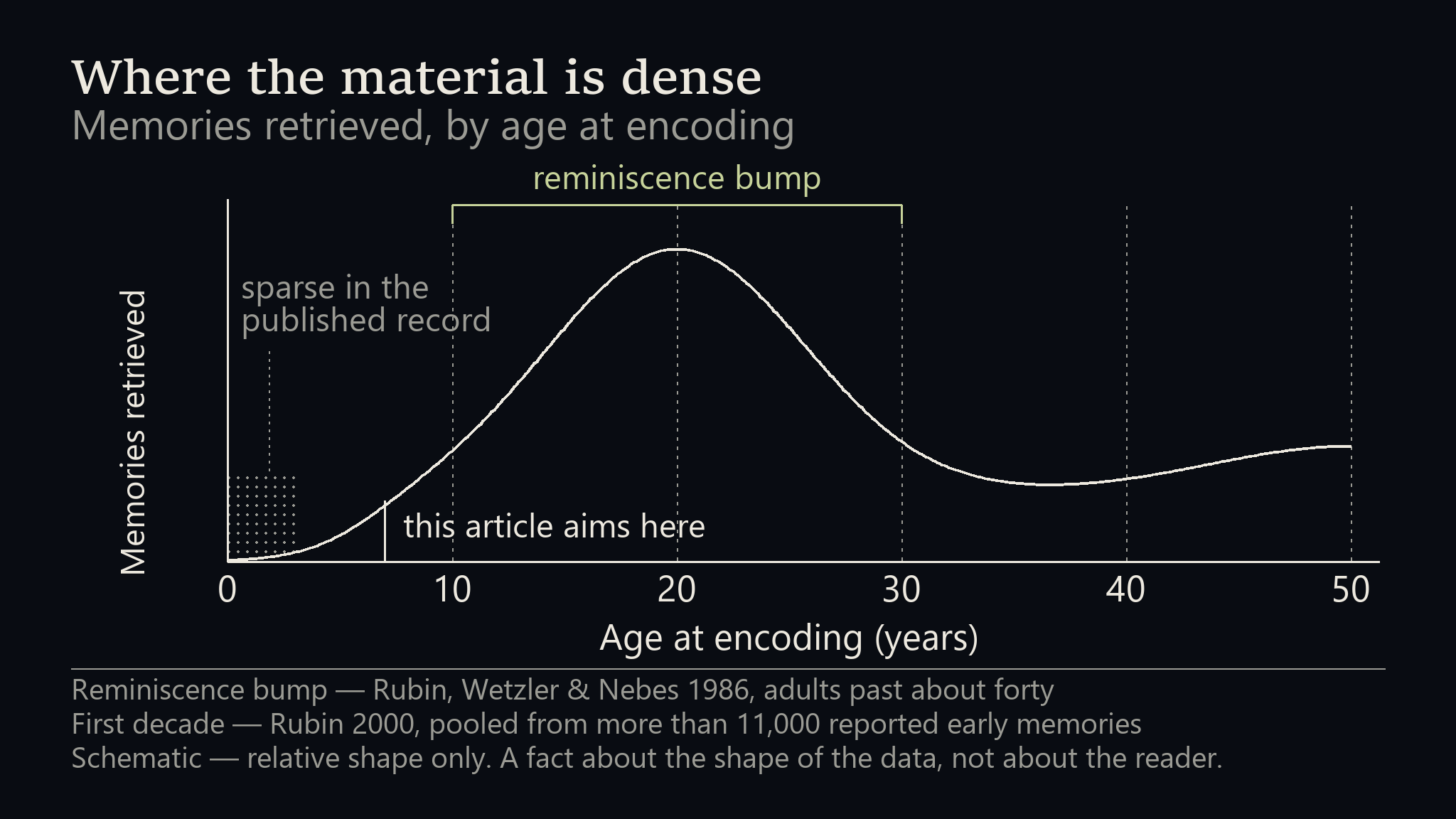
The second thing worth knowing before you aim is where the material is dense. Rubin, Wetzler and Nebes (1986, in Autobiographical Memory, Cambridge University Press, pp. 202–221) described what is now called the reminiscence bump: adults past about forty return disproportionately many memories from roughly ages ten to thirty. The bump is not early childhood. Childhood sits below it, in a thinner part of the distribution, which means a cue aimed at age seven has to be sharper than one aimed at nineteen to do the same work. This is a fact about the shape of the data, not a fact about you.
A good cue is specific enough to place you somewhere, and empty enough that it does not tell you what you found there.
What you remember and what you know
Recollecting a childhood experience and knowing a fact about your childhood are two different things, and only the first is what the cues below are built to reach. Recollection is first-person: the drawer, the lifting, the pull, arriving as something you were once inside. Knowledge is everything you can state about your childhood with no such experience attached — that you owned that coat, that your uncle was at that party — and most of it reaches you from outside, from photographs, from relatives, from the family version told at dinner. Both are worth having. They are not the same thing, and the difference is not always visible from the inside.
One rule follows from that, and every exercise below assumes it. Write the two in separate columns: what you recollect in one, what you know in the other, with the source named. Nothing moves from the knowledge column to the recollection column because it started to feel vivid. Anything you cannot place goes down as exactly that, a detail you cannot place, rather than into either column. This is the two-column rule, and the rest of this article refers back to it by name.
Place cues: start with architecture, not events
Spatial cues work because a room, unlike an event, has no plot to hand you: it can put you somewhere without also telling you what happened there. Events want to be told as stories, and a story is a finished object — it arrives pre-edited, and the edit is what you get instead of the day. Rooms have no plot. They just sit there and let you stand in them.
1. Draw the floor plan of one home
On paper, badly. One floor is enough. Put in the doors, then the furniture you are sure of, then stop. The stopping matters. Aim to notice where the pencil hesitates rather than to complete the drawing: the hesitation tells you where the cue is thin, and a thin spot is a place to aim a narrower cue.
2. Walk one route at walking pace
The way from your bed to the kitchen. The way from the school gate to your classroom. The way from a bus stop to a front door. Routes have order built into them, and order gives a stray detail somewhere to attach. Take the route in sequence, in real time, and stop at the first corner rather than trying to arrive.
3. Look up one address on a street map
Satellite and street-level imagery will not show you 1997, and you should not expect it to. What it can do is fix the geometry (which way the road bent, how far the shop actually was, which side the light came from), and geometry is cheap, reliable scaffolding to hang a cue on. Treat the current image as a map, not as a photograph of the past.
Sensory cues: the ones you did not choose
Sensory cues — smell, taste, sound, texture — reach a period through channels that words do not, and which sense you choose changes both how often something arrives and how much detail it carries when it does. The instinct is to reach for favourites: a favourite meal, a favourite place. Some of these you have handled so often you have rehearsed them into smooth stones, and then the ordinary details you never curated can have more purchase. Not everywhere, though. With music it is the familiar, well-liked track that cues more reliably, and the research on that is unusually clear.
4. Smell, with realistic expectations
Odour has the strongest reputation here and a more interesting reality. Chu and Downes reviewed the evidence in Chemical Senses (2000, 25, 111–116) and concluded, on what they explicitly called preliminary grounds, that olfactory cues can cue autobiographical memory more effectively than cues in other modalities. They also noted that odours prompt fewer memories than words or pictures do. In their later experiments (Memory & Cognition, 2002, 30, 511–518), odour-cued recollections were reliably richer in detail than the same memories cued by a word or an image. So they are rarer, but denser when they land. Work them by finding the smells nobody curated: floor polish, chlorine, a particular soap, wet playground tarmac, the inside of a plastic lunchbox. We take this apart properly in The Proust Effect.
5. Music you knew well, from one year
Start with the songs you actually knew and liked, the ones that were everywhere in a particular year and that you played on purpose. This is the one cue on the list where the modality-specific research is clear, and it runs the opposite way to the usual advice: the music that evokes a memory is reliably the familiar, well-liked kind. Jakubowski and Francini found high-familiarity tracks evoked roughly three times as many memories as unfamiliar ones, and faster (Quarterly Journal of Experimental Psychology, 2023, 76, 2001–2016); Janata, Tomic and Rakowski found the songs that surface a memory tend to be both well known and well liked (Memory, 2007, 15, 845–860). So find a chart listing for one specific year and play what you knew. A second, less certain pass: the radio filler and advert jingles you never chose were less rehearsed, so they may have kept sharper edges. That is a craft guess, and nobody has shown they cue more.
6. One dish, cooked the way it was cooked then
Not the celebration food. The Tuesday food: the thing that appeared weekly, made slightly wrong, eaten in front of something. Cook it the wrong way on purpose — the way it was actually made, with the cheap ingredient. Taste and smell run together, and the ordinary version is the one that was there most often. Set expectations accordingly, though: in the largest head-to-head comparison of the senses, taste was among the weakest cues, producing fewer and less detailed memories than sight, sound or touch, though it did have one knack, for turning up memories that had not been recalled before (the “Proust Machine”, Frontiers in Psychology, 2020).
7. What your hands knew
Objects that were handled hundreds of times carry more than objects that were admired. A stiff latch. The weight of a school bag on one shoulder. A specific pen. The texture of a sofa arm you picked at. Physical routine is dense, unrehearsed, and almost never asked about.
Join the Ecphory waitlist — one carefully chosen memory cue each week until launch.
Double opt-in; unsubscribe anytime. Privacy.
Document and social cues: handle with a distinction
Documents and other people supply more raw material than any other cue on this list, and they are the only cues that can put something in your head that was never there. Being careful with them is worth more than being encouraging.
8. Photographs, used as cues and not as sources
A photograph gives you two different things and they are easy to confuse. It gives you knowledge: that you owned that coat, that the sofa was brown, that your uncle was there. And it may give you recollection: the first-person experience of having been there. What you know from a photograph is not the same as what you remember, and after enough looking the two become genuinely hard to tell apart from the inside.
So work photographs edge-first. Ask what was immediately outside the frame, what happened in the ten minutes before the shutter, who was holding the camera, what the room smelled of. The frame’s contents are already available to you as facts; the answer you want is the part the picture cannot supply. And when you write anything down, mark which of the two it is — the two-column rule, applied to a single photograph.
9. Paper and objects with your handwriting on them
A school report, a margin scribble in a textbook, a birthday card you wrote, a ticket stub in a drawer. These are unusually good cues because they are dated, specific, and were produced by you at the time rather than curated afterwards. A school report in particular hands you a year, a room, a name and a judgement in one object.
10. Ask a relative for their version — and label it as theirs
Ask narrow questions: not “what was I like”, but “what did our kitchen table look like” or “what did I refuse to eat”. A relative’s answer is testimony. It is evidence about the world, and it is a very good cue, but it is not your recollection, and it does not become your recollection by being repeated. Under the two-column rule, testimony goes in the knowledge column and stays there. The reason for the pedantry is in the accuracy note below, Vivid is not the same as accurate.
Temporal scaffolds: give yourself a grid
Time is a poor cue on its own, but a very good index. If you can date something, you can aim.
11. Use school years as the grid
School years are the most reliable index most people have: each one comes with a room, a teacher, a route, a set of classmates and a fixed length. Take one year, name the room, name who sat next to you, then work outward from there into the parts of that year that had nothing to do with school.
12. Anchor to “the year X happened”
A move, a new sibling, a change of car, the winter the pipes froze, the summer of the extension. Datable household events are useful precisely because they are boring and verifiable, but keep them in their lane. When people lean on a personal landmark, it sharpens their judgement of when another event happened without improving what they recall of what happened (Zwartz and Sharman, Applied Cognitive Psychology, 2013, 27, 286–290). So anchor the year first (the year the kitchen was redone), then cue that year with something sensory or spatial: stand in one of those two kitchens and reach for the drawer that stuck. The before-and-after is for sorting; the sensory cue is what actually reaches in.
Worth knowing where the grid ends. Pooling more than 11,000 early memories from the published studies, David Rubin mapped the distribution of memories from the first decade of life (Memory, 2000, 8, 265–269): reports from the first two or three years are very sparse, then climb steeply through the preschool years, with no single sharp cut-off marking the edge. Researchers call this scarcity of the earliest years childhood amnesia. It is a statement about where a cue can reach, a feature of how autobiographical memory gets built in everybody, and not an explanation of anyone in particular.
Vivid is not the same as accurate
A childhood memory can arrive vividly, in detail and with feeling, and still be wrong — and vividness is not a signal you can use to sort the two. Everything above changes what is likely to come to mind. None of it makes what comes to mind true.
Elizabeth Loftus and Jacqueline Pickrell showed how easily the line moves (Psychiatric Annals, 1995, 25, 720–725). Twenty-four participants were given short write-ups of childhood events supplied by a family member. One write-up was fabricated: being lost in a shopping mall at about age five. About a quarter of participants came to report remembering that event, some of them in detail, some of them with feeling. The suggestion came from a trusted relative, and that was enough.
This is what the two-column rule is for, and it costs nothing. Keep what you recollect in one column and what you know — from a photograph, from a relative, from the family version told at dinner — in another. And when a detail arrives that you cannot place, write it down as a detail you cannot place, rather than promoting it to a fact because it arrived vividly.
When a cue lands on nothing
This is the part that decides whether the method is any use to you. A cue that returns nothing did not match, and there are exactly three legitimate next moves.
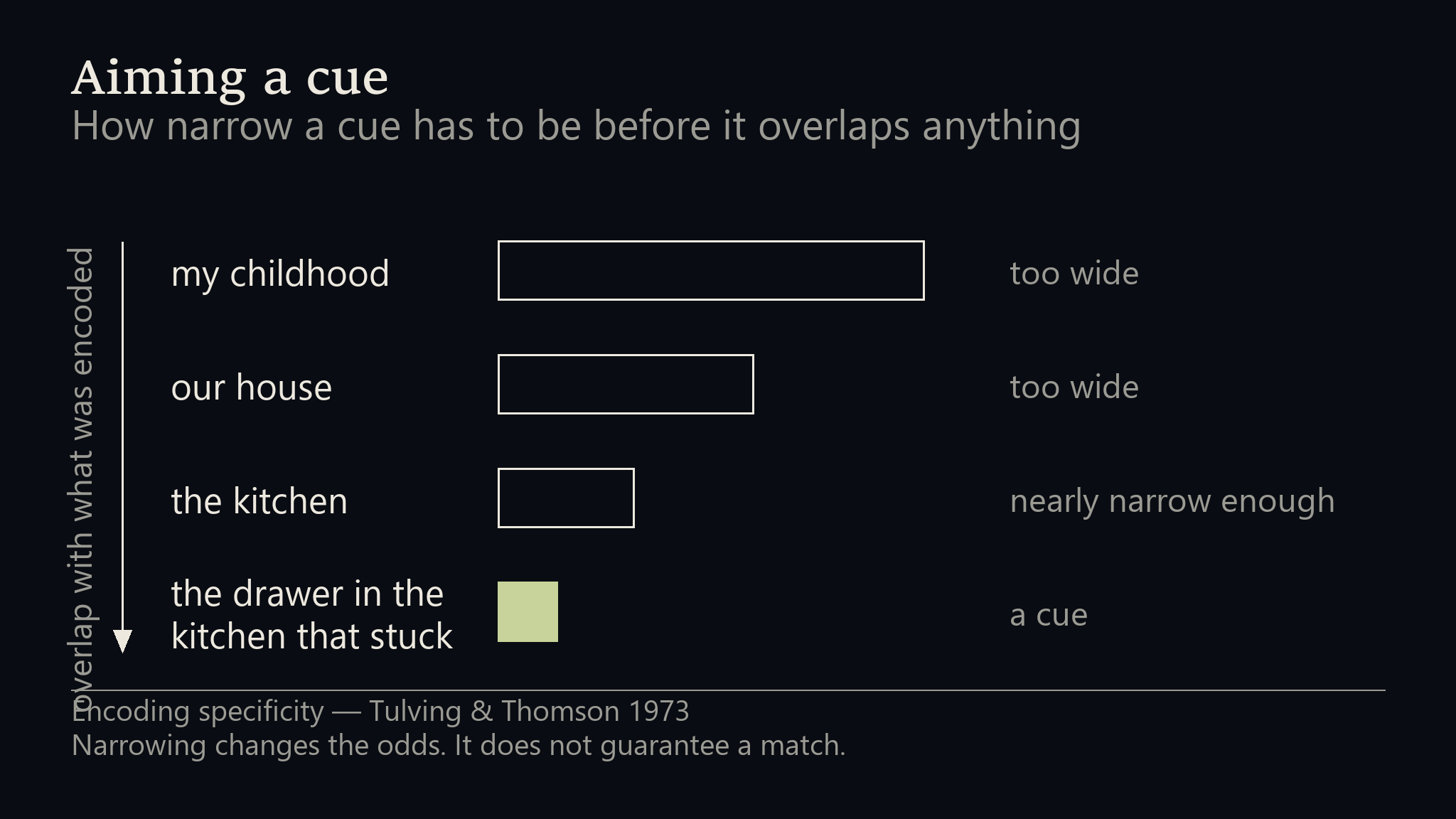
Aim narrower. This is the one that does most of the work. Almost every cue that returns nothing is too wide. “My childhood” is too wide. “Our house” is too wide. “The kitchen” is nearly narrow enough. “The drawer in the kitchen that stuck” is a cue. Move from the era to a named thin anchor inside it — one doorway, one smell, one particular Tuesday — and cue from there. A narrow cue is more likely to find a match than a wide one; it is not guaranteed to, and nobody can tell you in advance which narrow cue will be the one.
Change the cue. Sensory and spatial cues approach a period from different directions, and the direction matters. If a room gives you nothing, try the sound the front door made. If sound gives you nothing, try the route. You are not trying harder at the same door; you are walking round the building.
Or stop. Stopping is a complete answer, not a pause before trying again. You can put a cue down and leave it down, and nothing follows from having done so.
None of those three moves is an interpretation. A blank is not evidence about you, about your family, or about what is or is not in your head. The correct response to a cue that did not match is another cue, or none.
Draw the floor plan of one home you lived in before you were twelve. One floor is enough, and it does not have to be to scale. Then pick a single room and put one object back into it: the thing that was always in the wrong place.
You can stop at any point. You do not have to continue, and you do not have to finish the drawing.